Showing posts with label Film Reviews. Show all posts

Saturday, 11 February 2012

Mary & Max Film Review


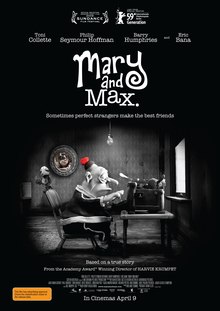
Fig1, Mary and Max (2009)

"Mary and Max" is an Australian stopmotion production, released in 2009. Its written and directed by Adam Elliot. In the mid-70s, Mary, an 8 year old girl from Melbourne, Australia, gets in contact with a random person whom she finds in a Manhattan address book via mail. The receiver of the letter is 40 year old Max, an overweight man who lives in New York. The story is now clear, we see how these two very different individuals bond through pen and paper over the years.

Fig2. Mary (2009)

[1]"A very odd, very unlikely animated film from Australia that manages to be sickly-cute, alarmingly grotesque, and right-on at the same time – often in the very same scene." (Pulver,2010) The film is simple, but this simplicity does not take away from its immense visuals. Mary & Max is one of those films that comes as a complete departure from a lot of the other films made these days, both in visual and storytelling style, and is iconic because of it. Also, the film cuts deep in the heart of the audience, especially to those who feel they may not fit perfectly in this world. It gives a personal feeling makes us feel as if we are experiencing this for ourselves.

Fig3. Max and Mary, (2010)

Something particularly peculiar and interesting about the films story is the way it explores adult themes, and more so, the amount of engagement and understanding Mary shows towards this. Their letters consist of talks about mental illnesses and sex, while the story touches upon death, suicide, alcoholism and many other things a respectable adult wouldn't indulge so deep and meaningfully into with a child aged 8. Julie.D also sheds some light and reasoning on this point in her review, [2]"There is plenty of humor, some of it rather subtle, although the movie often surprises with how serious some of the subject matter is and the depth to which the filmmaker is willing to explore it. This is all aided by the fact that Mary and Max are each, in their own way, complete innocents who write exactly what they are thinking, whether it will hurt or confuse the other person or not." (D, 2010) They do, however, grow with each other over 20 years. These letters provide deep meaning to their friendship resulting in Mary coming over to New York to see Max.


Fig4. Max at a bus stop, (2009)


Looking at the film from a stylistic point of view, one might say it is a dark and dismal version of Wallace & Gromit when put side by side, but its also broken the mould and has become something else, something of its own. The characters are a lot more exaggerated, the animation more detailed and the story is something that will leave footsteps in your memory.


Bibliography:

1. Pulver, Andrew (Thursday 21 October 2010), Mary and Max – review In: Guardian.co.uk [online] Available at: http://www.guardian.co.uk/film/2010/oct/21/mary-and-max-review

2. D, Julie (Monday, August 9, 2010), Confuzzlement* Abounds: Reviewing Mary and Max In: happycatholic.blogspot.com [online] Available at:  http://happycatholic.blogspot.com/2010/08/confuzzlement-abounds-reviewing-mary.html


Illustration List:

1. Adam Elliot (2009), Mary and Max [electronic print] Available at: http://en.wikipedia.org/wiki/Mary_and_Max

2. Adam Elliot (2009), Mary [electronic print] Available at: http://giftingdeadbirds.wordpress.com/2011/08/10/mary-and-max-2009/

3. Adam Elliot (2010), Max and Mary [electronic print] Available at: http://happycatholic.blogspot.com/2010/08/confuzzlement-abounds-reviewing-mary.html

4. Adam Elliot (2009), Max at a bus stop [electronic print] Available at: http://www.thefilmpilgrim.com/reviews/mary-and-max-review/392/attachment/mary-and-max-review

Sunday, 23 October 2011

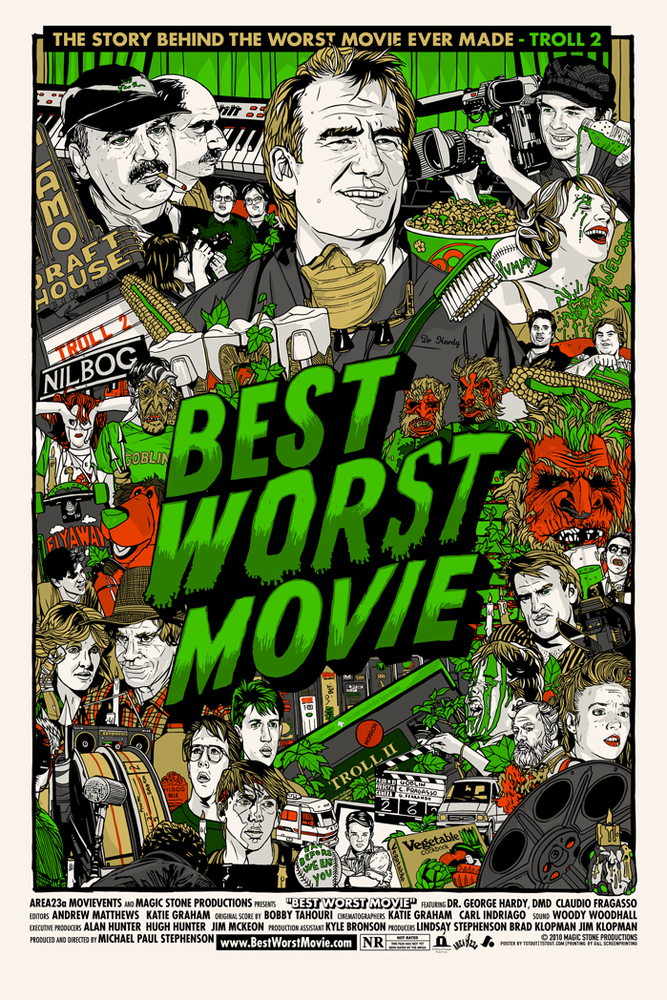
The Best Worst Movie/Troll 2 Review

[1]The Best Worst Movie (1989)


Troll 2, considered the "Best Worst Movie" in history, was directed by self proclaimed Italian director Claudio Fragasso and written by his wife Rossella Drudi . Claudio Fragasso was a writer of many films through the 70s and 80s. Troll 2 however stood out for its uniquely epic failure...

The Best Worst Movie was a tribute documentary to Troll 2, made nearly 20 years after in 2009. It looked back at the making of the film Troll 2 and its journey from being crowned the "worst film of all time" to a cherished cult classic. The documentary follows the Troll 2 film star Michael Stephenson  (the child star of Troll 2) as he sets out on his new adventure of discovering this new found Troll 2 cult. He travels the country in search of fellow cast members such as George Hardy, Margo Prey and  Jason Steadman. He speaks to fans and cast members of Troll 2 to find out how a low-budget horror film, directed by an egotistical and thickly accented Italian starring a cast full of amateur actors, found itself as being a cult classic.


[2]Joshua Waits in Troll 2, (1990)

"TO SAY A FILM IS “the worst movie ever made” is not only a bold statement, it’s a subjective one." (FilmFather, 2010).

Of course, naturally it is technically impossible to brand a single movie as being "the worst ever made", as its a very delicate, opinionated and argumentative subject. "FilmFather" says  [2]"there are definitely films with worse acting, cinematography, set design, etc. to rank them lower in the bowels of cinema sin."(FilmFather, 2010) which accentuates this point. One thing which could prove Troll 2 perhaps wasn't the worst film ever is the fan base that bought into the film through word of mouth and created this cult of spawning special screenings, Troll 2-themed parties, even body art, all dedicated to the "awfulness" of this film.

Evidently, each audience provide their own different views. Reviews of films from that of critics and film snobs will be much more serious and formally assessed, looking more into specific details about the film in terms of storyline, plot etc. On the flip side, a review derived from a fan, or just a general person who enjoys films, will approach their review in a more general matter, looking also at things that maybe a critic would feel is irrelevant such as the what the film has gone on to inspire. This is something Troll 2 has become most renowned for, and what has made it so popular in the first place despite what the critics think.


[3] Troll 2 fans, (2010)


Illustration List:

[1] Michael Stephenson (2009), The Best Worst Movie [electronic print] Available at: http://www.heyuguys.co.uk/2010/04/03/tyler-stouts-best-worst-movie-posters/

[2] Michael Stephenson (2009), Joshua Waits in Troll 2 [electronic print] Available at: http://eternalsunshineofthelogicalmind.blogspot.com/2009/05/best-worst-movie.html

[3] Michael Stephenson (2009), Troll 2 fans (2010) [electronic print] Available at: http://www.msnchannel.net/?p=33771

Bibliography:

[1] FilmFather (December 18, 2010), Best Worst Movie (2009) In: filmfather.blogspot.com [online] Available at: http://filmfather.blogspot.com/2010/12/best-worst-movie-2009.html

[2] FilmFather (December 18, 2010), Best Worst Movie (2009) In: filmfather.blogspot.com [online] Available at: http://filmfather.blogspot.com/2010/12/best-worst-movie-2009.html

Wednesday, 12 October 2011

Lost In La Mancha: Film Review

[1] Lost In La Mancha (2002)


[1]"There's no shortage of disaster stories in the history of film production, but none have been recorded with such frankness, immediacy and aching sense of disappointment as in Lost In La Mancha... entertaining and instructive... a tantalizing memorial." (Derek Elley, VARIETY)


Lost In La Mancha is a "film" directed by Keith Fulton and written by Terry Gilliam. In the poster it is described as "Fabulous... One of the best movies ever made about a movie". This is what the film is all about, a film that came so close, yet so far from completion.

This film is all about a film, called "Lost In La Mancha", that was never made due to mass delays, injuries and other unfortunate mis-haps. In conclusion, the film ended up being released as a "making of" film, following Fulton and the cast & crew around the world as they film LILM, scene by scene.

Writer Terry Gilliam (right) on set with french actor Jean Rochefort
Terry Gilliam is a well known writer of films and has been nominated for a number of awards, including an Oscar. One thing about Gilliam which potentially lets him down however is his inability to stick to a set budget, he constantly pushes the boundaries of every project he makes well beyond the limit budget wise. Time Bandits (1981), The Adventures of Baron Munchausen (1988) and The Imaginarium of Dr. Parnassus (2009) are just a few titles by Gilliam which, of course, went over budget.

An in-depth astrological reports website states; [2]"Terry Gilliam is extremely strong-willed and he pursues his goals and desires with passionate dedication and determination." (Topsynergy). Of course, anybody who knows anything about Gilliam wouldn't doubt his passion and dedication, but this really shines through during the making of LILM. The effort of trying to piece together a film that you have always wanted to make, running into many problems and hold ups along the way, only to find you simply cannot make it due to injured actors, low funds and other issues must be indescribably frustrating. To repeatedly want to go back and do it all again or to pick up where you left off one day however, is Gilliams true passion an determination to pursue his ultimate goal.

I believe Gilliam was swallowed by his fantastical film ideas and ambitions, [3]"Gilliam admits the idea had obsessed him for years" (Derek Elley, VARIETY). He Ultimately let the film get the better of him, sabotaging his chances all together. All in all, the little completed clips of the film looked promising enough to make a relatively interesting film, but sadly this will not compensate for the time and money that went into this whole production.


Bibliography:

[1] Elley, David (Feb. 28, 2002), Lost in La Mancha (Docu--U.K.). In: VARIETY [online] Available at: http://www.variety.com/review/VE1117917111/

[2] Topsynergy, Terry Gilliam drive and ambition. In: Topsynergy [online] Available at: http://famous-relationships.topsynergy.com/Terry_Gilliam/Drive.asp
[3] Elley, David (Feb. 28, 2002), Lost in La Mancha (Docu--U.K.). In: VARIETY [online] Available at: http://www.variety.com/review/VE1117917111/


Illustration List:

[1] Terry Gilliam (2002), Lost In La Mancha [electronic print] Available at: http://thecia.com.au/reviews/l/lost-in-la-mancha.shtml

[2] Terry Gilliam (2002), Writer Terry Gilliam (right) on set with french actor Jean Rochefort [electronic print] Available at: http://www.iwatchstuff.com/2009/05/here-comes-a-lost-in-la-mancha.php

Sunday, 3 April 2011

Winsor McCay (1867-1934)

Winsor McCay

[1]McCay, (1906)

Zenas Winsor McCay was born in 1867 in Canada. He was named after his father's employer and he quickly dropped Zenas in favor of Winsor. He was raised in Michigan where he started drawing from a very young age. [1]"At the age of 13 he drew a picture of shipwreck on the school blackboard and it was photographed and copies sold" (Canemaker, 1987). Winsor was a boy who loved to draw and never stopped from the day he started.

After working at Wonderland in Detroit for a little while, where he was hired to draw portraits of the customers, He started moving around a lot for work. [2] "McCay left Michigan for Chicago in 1889 where he worked for a printer and roomed with Jules Guerin. In 1891 he moved to Cincinnati. There he settled into the only type of work he knew - he went to work as a staff artists for a local dime museum." (Canemaker, 1987). It was here that he also took drawing lessons from a local instructor who taught perspective drawing. McCay also started drawing for the local newspaper, where he had to start using pen instead of his preferred pencil and paints. He did alot of little bits of work here and there and it wasnt until 1903 where he got An invitation to take a job at the New York Herald.

[2]Little Sammy Sneeze comic strip, (1904-1906)


For years Winsor McCay worked on many different strips over different time periods, with some overlapping. Little Sammy Sneeze, Dream of the Rarebit Fiend and A Pilgrim's Progress are but some of McCay's strips he done while at the New York Herald. These were all very wonderful within their own right, but they were almost like a run up and a learning curve to what McCay really had instore for his "masterpiece".


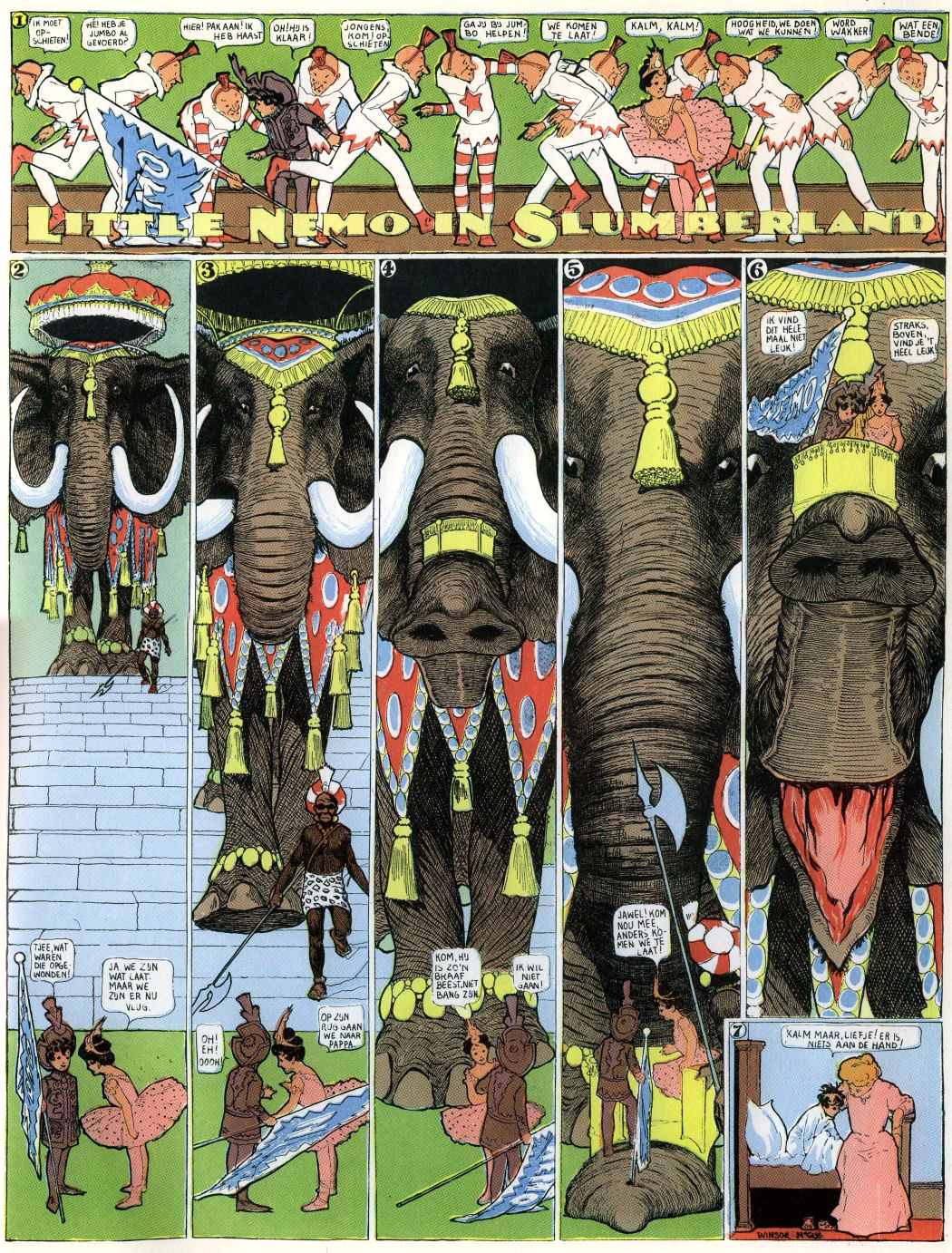
[3]Little Nemo In Slumberland, (1905)

[3]"Simply put, Little Nemo revolutionized the comic strip. At 38, McCay was at the very peak of his talent and the New York Herald had the most talented and creative color printing staff in the business.(Canemaker, 1987).  On October 15, 1905, "Little Nemo in Slumberland" debuted, which insantly revolutionised the comic strip. Just like McCays earlier strip "Dreams Of A Rarebit Fiend", Little Nemo was set in the dreams of the character and featured fantasy art that attempted to capture the look and feel of dreams.

[4]"Within five years of arriving in New York, McCay had become one of the top artists and performers in the city. Both his comic strips and his vaudeville act were based on pacing and movement. He was about to combine all of these elements into one new art - the animated cartoon."(Canemaker, 1987).


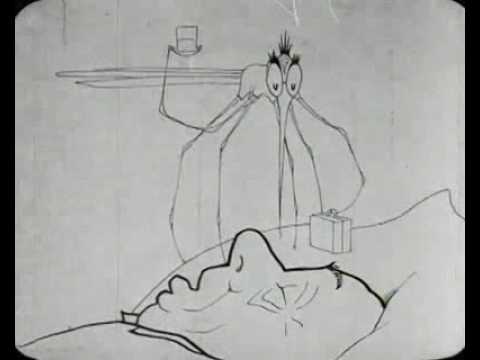
[4]How A Mosquito Operates, (1912)

Now, McCay was not the first person to make an animated cartoon, but because of his previous work and his great understanding of drawing in motion, he is said to be the man who defined the industry. McCay drew every frame of Little Nemo himself, which is a very daunting task considering its made up of 4000 pictures. He was also still working on his 3 comic strips a week for the newspaper during the making of Little Nemo. His next animation called "How A Mosquito Operates", was madeup of 6000 drawings and was also released in theatre. When these two films were released, McCay's fame spread ever further throught what was not established as th "animation community".


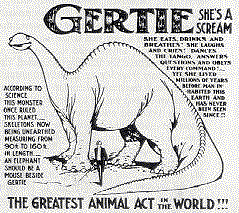
[5]Gertie The Dinosaur,(1912)
[5]"Released in 1912, Gertie was originally part of a Vaudville stage show in which McCay directed his dinosaur from stage right."(Gross, 1997)

Not so long later, Gertie The Dinosaur was released in theatre. This was an animatied cartoon about a dinosaur named Gertie and was made up of over 10,000 drawings. Because of the amount of work this was, Winsor McCay called on the help of John A. Fitzsimmons who would assist his in the making of the animation, Fitzsimmons job was to draw all the background for the animation while McCay focussed on the animation of Gertie.

[6]"You can imagine the frenzy when McCay's drawing actually began moving around! Not only could he command Gertie to hop from one foot to the other, or watch helplessly as she toyed with the small mammoth Jumbo, but he even did the amazing by throwing her food and then entering the picture himself!" (Gross, 1997)

Since animation was still quite largely unknown at the time McCay was working, it was like he was practically reinventing the wheel! With his first few animations spreading across america and becoming quite an attraction for a lot of people, there were still a majority of people who were not convinced, and thought it was all a trick. When Gertie The Dinosaur was released, it was a great astonishment and it only proved animation to be real.


Illustration List:

[1] Winsor McCay, (1906). Available at: http://en.wikipedia.org/wiki/File:Winsor_McCay.jpg

[2] Little Sammy Sneeze comic strip, (1904-1906). Available at: http://en.wikipedia.org/wiki/File:Petit_Sammy_%C3%A9ternue.jpg

[3] Little Nemo In Slumberland, (1905). Available at: http://en.wikipedia.org/wiki/File:Little_Nemo_Elephant_1.jpg

[4] How A Mosquito Operates, (1912). Available at: http://animationreview.wordpress.com/2010/06/20/how-a-mosquito-operates/

[5] Gertie The Dinosaur, (1912). Available at: http://www.enchantedlearning.com/subjects/dinosaurs/questions/Qns99Nov.shtml


Bibliography:

[1] Canemaker, John (1987). Winsor McCay In: bnip.com. [online] Available at: http://www.bpib.com/illustrat/mccay.htm

[2] Canemaker, John (1987). Winsor McCay In: bnip.com. [online] Available at: http://www.bpib.com/illustrat/mccay.htm

[3] Canemaker, John (1987). Winsor McCay In: bnip.com. [online] Available at: http://www.bpib.com/illustrat/mccay.htm

[4] Canemaker, John (1987). Winsor McCay In: bnip.com. [online] Available at: http://www.bpib.com/illustrat/mccay.htm


[5] Gross, Cory (1997), The Lost World: Gertie The Dinosaur In: silentmoviemonsters.tripod.com. [online] Available at: http://silentmoviemonsters.tripod.com/TheLostWorld/LWGERTIE.html

[6] Gross, Cory (1997), The Lost World: Gertie The Dinosaur In: silentmoviemonsters.tripod.com. [online] Available at: http://silentmoviemonsters.tripod.com/TheLostWorld/LWGERTIE.html

Thursday, 24 February 2011

The Birds: Review

The Birds
1963

[1]The Birds, (1963)

"The Birds" is a Horror/Thriller film directed by Alfred Hitchcock, starring Rod Taylor (as Mitch Brenner), Tippi Hedren (as Melanie Daniels) and Jessica Tandy (as Lydia Brenner)


[2]Mitch Brenner surrounded by birds, (1963)


The Birds is, for the most part, quite a horrific film. Trying to imagine one self in the same position Brenner and his family are in, having to live through the same experience and suffer the same consequences with no warning at all, is quite horrendous. By looking at the film in a different light however, similar to the way Scheib describes, it can become quite hilarious. The fact that this girl called Melanie Daniels has come to town unexpectedly, and now suddenly the place has been taken over by birds of different kinds is amusing. The amusement is born from the confusion everyone (including the audience) is facing. The most important thing overall is that this puzzling story with crazy birds is what makes The Birds what it is, without the bird factor there is no conflict, and without conflict there would potentially be no film because everyone will just live happily ever after (which doesnt happen in the majority of horrors).


[3]Melanie at the bar, (1963)


As well as a puzzling story, the film also has a lot of prolonged scenes of people just looking at eachother or something in the distance. Now, there is a difference between it being a reasonably prolonged shot, and when the shot is just noticably too long for no apparent reason (which woud be classed as unprofessional nowadays). An example of a shot "over done" would be when the teacher (Annie Hayworth) is shutting the doors at the birthday party after getting all the children inside; 2 kids poke their heads around each of Hayworths thighs and stare into the sky for a good 5-7 seconds. There is no justification for this as it doesnt lead us anywhere and the children dont even have any lines at that point, the scene just simply fades out into the next.

Another oddity of this film is the birds sometime-ish behaviour. From early on we see that the birds of Bodega Bay are more ferocious then in other areas, starting with a seagull's solo attack on Melanie to get the ball rolling (and to act as a warning) followed by bigger more planned attacks by gangs of birds as the film goes on. On the odd occasion however, the birds will just sit and watch as Melanie just walks right by. This is evidently done to build suspense, because Hitchcock has cleverly decided to show some mercy in the scenes the audience is more likely to expect an attack to occur, but at the same time it makes the film a bit silly. Yes seagull's, crows and raven's all have minds of their own, but surely they are more likely to strike their prey when its out in the open and not barricaded inside a house with layers of wood nailed to each and every opening...come on now!


[4]Mitch barricading door, (1963)

In terms of the actual story I agree with Warren's statement, and feel the emphasis of the birds overshadow the story of Melanie Daniels. The film is good, but not that good compared to Hitchcock's other films like Psycho for instance. The fact that Daniels indeed isn't likable also puts towards the point that its hard to make a connection with her as an audience. The detrimental effect of this is that we do not grasp the whole concept of why this havoc is taking place as well as we should. However, the film isn't all that bad and is worth a watch.

Illustration List:

[1] Alfred Hitchcock (1963), The Birds [electronic print] Available at: http://en.wikipedia.org/wiki/The_Birds_(film)

[2] Alfred Hitchcock (1963), Mitch Brenner surrounded by birds [electronic print] Available at: http://www.brummieblogs.com/2007/BBFebruary2007.htm

[3] Alfred Hitchcock (1963), Melanie at the bar [electronic print] Available at: http://bavatuesdays.com/the-birds/

[4] Alfred Hitchcock (1963), Mitch barricading door [electronic print] Available at: http://robie2008.wordpress.com/100-best-greatest-favorite-films/

Bibliography:

[1] Scheib, Richard (1999-2011), The Birds In: 0to5stars-moria.ca [online] Available at: http://0to5stars-moria.ca/horror/birds-1963.htm

[2] Scheib, Richard (1999-2011), The Birds In: 0to5stars-moria.ca [online] Available at: http://0to5stars-moria.ca/horror/birds-1963.htm

[3] Sponseller, Brandt (2001), The Birds (1963) In: Classic-Horror.com [online] Available at: http://classic-horror.com/reviews/birds_1963b

[4] Warren, Bill (March 28, 2000), Birds, The (Collector's Edition) In: Audio Video Revolution [online] Available at: http://www.avrev.com/dvd-movie-disc-reviews/mystery-suspense/birds-the-collectors-edition.html

Sunday, 13 February 2011

Psycho Review

Psycho
1960

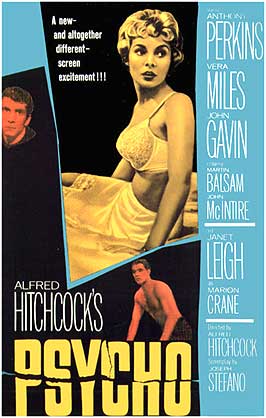
[1]Psycho, 1960
Psycho is a 1960's horror thriller directed by Alfred Hitchcock, starring Antony Perkins, Janet Leigh, Vera Miles and John Gavin. The film is about a woman named Marion Crane who steals $40.000 from her employers client (who flaunts the money around) and goes on the run across America. After constant rejection from many motels, she finds herself at "The Bates Motel" which is just off the highway. Here she meets a weird motel proprietor named Norman Bates (Anthony Perkins) who is under the domination of his mother (which we don't know yet). Here is where Marion meets her doom, but is that the end of the story..?

[2]Norman & Marion (1960)


After watching the first handful of scenes up to where Marion is buying a new car, the story had already seemed to be established. She has already stolen the money and is on the run, and this anonymous police officer is also following her which also leads the audience to believe that he is onto her and that eventually she will get caught. The fact that the story takes a turn from that scene onwards (after she buys the car) is very mystifying. This confuses the audience, gets them trying to re-anticipate the film and provides more suspense in the long run, this is a good tactic from Hitchcock. What is more confusing is that the main character, Marion, gets killed "prematurely". I say prematurely because we are skillfully manipulated into believing that, since she is the lead character, she will live til the end of the film (or at least the second half of the film). This makes Marion a secondary MacGuffin, after the $40.000, because although it might not be clear to the naked eye, Marion is killed for a reason which we later discover.
The fact that she does die is very baffling to begin with, since everything gathered from the story has now suddenly been turned on its head and we are just left hanging, wondering "so... what now?" Hitchcock's techniques voyeuristically implicate the audience with the universal, dark evil forces and secrets present in the film. This shouldn't surprise you too much if you are an avid Hitchcock fan however, as most of his films run by this layered and complex narrative style. Some may need to see his films more then once to fully grasp the story and all of its subtlety.
The concept of killing Marion early, and the actual shower murder scene itself, is one of the most discussed and memorable scenes in cinema history. The scene took an entire week to shoot and is simultaneously horrific and tantalising without any actual penetration of the knife or any visible lady parts. This on the whole was a big gamble by Hitchcock but it was a great success. The effect it has on the audience is that, quite simply, the protagonist is not supposed to die halfway through the movie! Of course, this aspect of the film is part of what makes the legendary shower scene so tragic. Viewing the scene on its own will only leave the majority of people wondering what all the hype is about, but seeing it in the film really makes your mind boggle. The first part of the film was all about getting to know Marion, understanding her situation and creating a subtle bond with the character. This is all part of the process in building the suspense and making that shower scene so, so shocking.

[3]Norman finds Marion (1960)

[3]"This isn’t a gory film, and what few instances of violence take place with relatively little actual on-screen violence. In fact, it contains just three big shocks, with the rest of the 110-minute running time devoted to setting scenes, building suspense and playing with our minds." (Panton, 2004)

As said before, Hitchcock cleverly plays with our minds to create the tension this film brings without the use of violence an gore. The centre of attention when looking at the horror of the film is the Bates Motel itself, from its dark and dingy look to its setting in the middle of nowhere. The film bears resemblance to films like "The Haunting (1963)", with the house also being set in a baron location, and "Cat People (1942)" with all its suggestiveness. Psycho has only 3 shock moments, which clearly demonstrates that a horror/thriller can be just as thrilling, if not more, without all the sometimes unnecessary dramatics's of other horrors. Even to this day, film directors fail to understand this and write films full of blood and gore with no story definition to back up these acts. This reason alone is why Psycho still stands as one of the best films in history and should be a real eye opener to those people seeking influence.


[4] Sam Loomis Behind Norman Bates (1960)


[4]"Yet although Psycho laid a blueprint that has been emulated in varying degrees ever since, Hitchcock's original formula for slasher films is still hauntingly original." (Justice, 2004)

Psycho is a very unexpected film, you cannot anticipate anything before you see it; the death of the protagonist is not the only unexpected occurrence. Firstly, the film is shot in black and white, which Hitchcock had supposedly stopped doing sereval films ago. *SPOILER ALERT* Norman actually happens to be a transvestite, who pretends to be his mother (who had died some years ago) and the supposedly smart detective who's supposed to save the day gets killed (quite unexpectedly, but also easily) *SPOILER ALERT OVER*. These choices of circumstances are all quite original to Hitchcock when put together in this way, for example you do not expect a serial murderer to be so quiet and harmless in his portrayal of character (when this film was made), and also be a schizophrenic transvestite.

Another thing about this film is, although its probably hard to believe, Marion and Norman are quite similar characters. They both are "drifters" in the sense that neither of them are comfortable with their lives and they both roam the outside world, seeking answers to some kind of unspoken mysteries of their own. Marion is seeking a real relationship with Loomis, or money, or some kind of escape from her pedestrian role as a secretary. She seeks somewhere where she has more self control over what she does and she wants happiness. Norman is seeking a few things, e.g a stable living, maybe away from his house etc, which is far too complex to capture in the film. The movie suggests that the traditional American "home" is empty and somewhat impersonal, like its just a rented space devoid of tradition and homeliness and just filled with materials used to satisfy personal needs (Normans stuffed birds for example). This establishment of the lack of a base for these characters further adds to the films disorientation value and makes viewers feel more uncomfortable.


[5] Norman as Mrs Bates (1960)

Overall, Psycho is just one of those films hailed one of the greatest of all time which will live on for ever. I agree it is a great film with a cleverly written storyline and well executed scenes. If you have yet to see the film, well, what are you waiting for?

Illustration List:

[1] Alfred Hitchcock (1960). Psycho [electronic print] Available at: http://www.filmsite.org/psyc.html

[2] Alfred Hitchcock (1960). Norman & Marion [electronic print] Available at: http://www.obsessedwithfilm.com/features/50-reasons-why-psycho-is-the-greatest-film-of-all-time.php

[3] Alfred Hitchcock (1960). Norman finds Marion [electronic print] Available at: http://collectiverambling.wordpress.com/2010/08/18/a-love-letter-from-norman-bates/

[4] Alfred Hitchcock (1960). Sam Loomis behind Norman Bates [electronic print] Available at: http://www.thelightningbugslair.com/2009/10/hitch-on-hump-psycho-1960-part-3-were.html

[5] Alfred Hitchcock (1960). Norman as Mrs Bates [electronic print] Available at: http://letsrollforums.com/kurt-cobain-mind-control-t17443p32.html?s=b8138ad36703a5c2cb8f119e28d61f38&

Bibliography:

[1]Ebert, Roger (December 6, 1998) Psycho (1960) In: rogerebert.com [online] Available at: http://rogerebert.suntimes.com/apps/pbcs.dll/article?AID=/19981206/REVIEWS08/401010353/1023

[2]Justice, Chris (May 26, 2005) Psycho (1960) In: Classic-Horror.com [online] Available at: http://classic-horror.com/reviews/psycho_1960

[3]Panton, Gary (February 26, 2004) Psycho (1960) In: Movie Gazette [online] Available at: http://movie-gazette.com/656/psycho

[4]Justice, Chris (May 26, 2005) Psycho (1960) In: Classic-Horror.com [online] Available at: http://classic-horror.com/reviews/psycho_1960

Tuesday, 8 February 2011

Rope Review

Rope
1948:
 
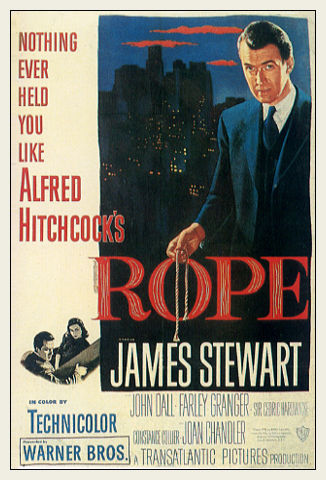
[1]Rope, 1948

Rope, Directed by Alfred Hitchcock, is a film about two men, Brandon Shaw (John Dall) and Phillip Morgan (Farley Granger), who strangle their "inferior" classmate and hide his body in a chest in their apartment. Soon after the murder they hold a dinner party in their apartment, as means to challenge the "perfection" of their crime they had just committed.

Rope is a great film which, when at its peak, will have the majority of people bracing themselves while sunk down into their seats; the amount of tension the film brings, along with some quite unexpected outcomes, is quite great. What gives this film even more gratitude is not just the acting however, but also the way it was made.

[2] Phillip, Rupert & Brandon. (1948)
[1]This film’s notoriety comes from how Hitch shot it, opting for a stage-like feeling, making the audience feeling like they’re watching a play by not cutting often and when he does he tries to hide the edits. (Quint, 2009)
The most famous feature about Rope is that it is (arguably) made with NO CUTS (with an exception of the one you see at the very start moving from the street to the murder scene). Hitchcock refused to include any intentional cuts, the only time cuts were made was when the film reel had to be changed over; this problem cant be avoided. These cuts were disguised by zooming into somebody's back for a couple of seconds them coming out again, this was when the reel would be changed. The film is also only shot from a few angles all on the same side of the room, this makes it feel like they are on a set. Among the different camera shot used, the longshots are the most impactful in portraying emotion. The use of the longshot down the hall when the maid is clearing up for example is very good at creating a high level of tension, it leaves us open to a bunch of outcomes expecially since they made sure to have the chest in the shot as it was slowly being stripped. Another good use of the longshot was when Brandon went to fetch some wine from the fridge. He is talking to the maid, convincing her that wine was fit for the occasion, but the shot used imposes that it is an arkward situation, almost like an "arkward silence' displayed through a camera.

[3] Phillip & Brandon at the dining table, (1948)

[2]The man they kill in this opening scene is a friend of theirs who has never done them any wrong. But these two are fucking crazy and just want to pull of a murder. (Quint, 2009)
 As for the story, it is very simple and short. Because of this we dont really get to understand what the actual plot of the film is about, for example why these guys decided to murder David and what they planned to do in after the crime. This part of the story that we sit and watch is great, but still doesnt make complete sense in the long run. The reason given for the crime is that Brandon and Phillip were inspired by a theory taught to them by one of their college professors that murder isn’t inherently wrong, but is only reserved for those who are special. That society’s rules are for the inferior. Because this is their only reason behind the murder it leads us to believe that these chaps must have a screw loose, and are even more crazy for believing they could show off about it straight afterwards by holding a dinner party, in celebration, involving the victims parents!


[4] Brandon on the couch, (1948)
  [3]Rope's final scene is one of the finest, most elegant Hitchcock ever shot. Night has fallen outside the apartment, and garish neon lights (flashing red and green) flood in as Rupert makes the discovery of David's corpse. (Muir, 2008)

This is a great scene as it is here you could say that things get "wrapped up", we see how the story is resolved. There is a big debate between the three of them which ends with Rupert feeling almost equally as responsible. He fires shots from the gun he wrestled off of Brandon out of the window and awaits the police. As we hear the sirens getting louder and louder, the flashing neon lights outside shine on their faces. This is very effective because the neons somewhat replicate the police lights and it feels like the film has suddenly fast forwarded to show them after already being caught, hence their miserable states.

Overall, Rope is a great film open to a wide variety of viewers.

Illustration List:

[1] Alfred Hitchcock (1948), Rope [electronic print] Available at: http://hitchcock.tv/mov/rope/rope.html

[2] Alfred Hitchcock (1948), Phillip, Rupert & Brandon [electronic print] Available at: http://www.aintitcool.com/node/42051 

 [3] Alfred Hitchcock (1948), Phillip & Brandon at the dining table [electronic print] Available at: http://somecamerunning.typepad.com/some_came_running/2008/11/milk-the-boys-in-the-band-and-teh-gay-agenda-in-cinema.html

[4] Alfred Hitchcock (1948),  Brandon on the couch [electronic print] Available at: http://www.flickr.com/photos/awkwardboyhero/4861777275/

Bibliography:

[1] Quint (August 14, 2009), A Movie A Week: ROPE (1948) You're quite a goodchicken strangler as I recall. In: Ain't It Cool News [online] Available at: http://www.aintitcool.com/node/42051

[2] Quint (August 14, 2009), A Movie A Week: ROPE (1948) You're quite a goodchicken strangler as I recall. In: Ain't It Cool News [online] Available at: http://www.aintitcool.com/node/42051

[3] Muir, John Kenneth (September 07, 2008), Cult Movie Review: Rope (1948). In: John Kenneth Muir's Reflections on Film/TV [online] Available at: http://reflectionsonfilmandtelevision.blogspot.com/2008/09/cult-movie-review-rope-1948.html

Sunday, 16 January 2011

The Shining Review

The Shining
1980

[1]The Shining, 1980

The Shining is a horror film made in 1980, directed by Stanley Kubrick and starring Jack Nicholson as the father of the family. The film follows a family who go to an isolated hotel for the winter. During their stay, an evil presence in the hotel influences the father (Jack Torrance) to be violent and short tempered. His son Danny however happens to have a special ability to see into the past and the future, this psychic ability enables him to see the fate of him and his family.

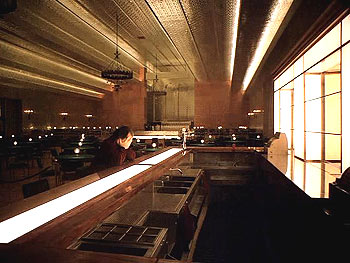
[2]Torrance in the Bar, (1980)

The main culprit of the horror in The Shining is the hotel itself, much like the film "The Haunted" by Robert Wise. The house- a huge, isolated Colorado mountain resort hotel called "The Overlook", is given its own ghostly character as it is empty and hosts a haunted presence within. We do not see much of its exterior, but the huge interior is where it holds many different rooms and area's such as kitchens, bars, librarys and most of all the infamous room 237. [1]"The Overlook would undoubtedly amount to one of the screen's scarier haunted houses even without its special feature, a feature that gives "The Shining" its richness and its unexpected intimacy. The Overlook is something far more fearsome than a haunted house--it's a home." (Maslin, 1980). I can easily agree with what is said here by Maslin, The Overlook is not like any other haunted house. Haunted houses are generally portrayed as being very gothic or evil looking and are based far away in a distant, eerie place i.e near a graveyard. The Overlook however is actually a home, a lot of people have to live there for work or because they haven't much choice. Also The Overlook isnt ugly or out of place, inside or outside, the only resemblance it has to your "everyday" haunted house is that it is far away from civilization, but that can be, in most cases, of the more important factors to creating a haunted house.

[3]Jack holding Danny, (1980)
The Shining is a musically driven, suggestive thriller throughout (but more so at the beginning). A lot of the tension is built up through the use of music, mostly the violin and piano, ending with a bump or climax that leads to nothing scary at all. A good example of this is at the end of the scene before we see Danny riding around the hotel. The suspense is built up so much just through the use of music, and ends with a crashing sound with the word "TUESDAY" bursting onto the screen. This concept has its good and bad points, good because it does a good job at gathering tension, bad because it can get a little tedious and disappointing always leading to nothing much. Funnily enough, that particular "Tuesday scene" has become quite a highlight simply because of its epic buildup before it, Janet Maslin from The New York Times states [2]"The Shining" may be the first movie that ever made its audience jump with a title that simply says "Tuesday." (Maslin, 1980)

[4]The Shining blood elevators (Intro), (1980)
The film is quite different in the way it portrays its peculiar nature. From the very start we are presented with a hallway which is being flooded with what looks like blood, literally gallons of it pouring out from a lift down a hall. This is a big statement of what the film is about, strange and peculiar, and also whats to come.[3]"Kubrick deliberately reduced the pace of the narrative and expanded the rather simple plot of a domestic tragedy to over two hours in length" (Dirks, 1980). The Shining is very drawn out, but not in a bad way. The concept is simple but Kubrick manages to elongate the story and does a good job at expressing the ultimate horror film of a man going mad due to many factors over time. Dirks goes on to say that Kubrick "created lush images within the ornate interior of the main set". Again, the first scene is eligible to come under this "lush images" category as the clash of the dull, outdated hallway with the rich red liquid suddenly gushing in is quite immense.


[5]Danny encounters the twins (1980)
Another good feature worth noting is Kubrick's clever use of camera angles and shots to make a normal atmosphere seem uneasy to the audience, these angles are most noticeable in Danny's scenes. In the scene where Danny is riding around the hotel, we (the audience) are put in an almost backseat view, following Danny as he whizzes around on his trike. The shot is done using a Steadicam and it moves side to side, zooms in and out ever so slightly from Danny's back and occasionally tilts to give an unparallelled view. This along with the disturbing synthesized soundtrack (made by Polish composer Krzysztof Penderecki) creates a very uncanny scene which otherwise wouldn't feel odd at all. It really pins you to your seat as you brace yourself for something to jump out at him, and us.


[6]Jack in the garden maze, (1980)

[4]"This is the story of a man gradually driven to destroy his wife and child, and it stops just short of pinpointing his rage."(Maslin, 1980)

The story is mainly about the haunted house having a bad effect on Mr. Torrance, which drives him mad, but this statement from Maslin does raise a good point along with some questions. Midway through the film we notice that Jack is easily irrirated by his wife Shelley's presence alone, but little do we know whether this is before or after the evil presence leaves its mark in Jack. This can be backed up by how little we know about their marriage, is their relationship a stable one? Do they fall out a lot or are they very happy together?
From what Kubrick does tell us about them it doesn't seem like they are the happiest they could be. Jack is constantly irritated with her and demonstrates this at its peak in the library scene when he is trying to work. Shelley simply comes in to check on him to see if he's alright and innocently offers to bring him something to eat, but this makes Jack livid and all she gets is frustration and curses thrown in her direction. Now, is this because of what the house is doing to Jack, or because she always disturbs him at bad times and "breaks his concentration" a lot?
Another instance which could explain their unstable marriage is the scene in room 237. Danny went in there and came back to his mother saying there was a strange woman in there who tried to do things to him. When Shelley heard this she begged Jack to check the room for this naked woman. Jack goes to the room to find this attractive looking woman in the bath, behind the shower curtain. Instead of interrogating the woman, like most fathers would probably do after what she's done to your son, he allows himself to be drawn into her and is seduced by her beautiful, nude body. This indicates that he is not satisfied with what he is getting (or not getting) in his marriage with Shelley. The only thing that stops him from going any further then a kiss with this woman is that she turns out to be ugly and old. This is another trick the house has played on him to test his commitment, and after seeing the little a fight Jack puts up to resist the woman, uses this against him to convice him of killing his wife and son. Mr and Mrs Torrance's marriage is a listless one, and it is revealed obliquely, so this is a point to take into consideration.

[7] Danny covering his eyes, (1980)

Overall, The Shining is an excellent film. It is similar to other suggestive horrors, but it has more differences of its own which make it unique in those ways.


Illustration List:
[1] Stanley Kubrick (1980), The Shining [electronic print] Available at: http://www.obscurehorror.com/horror515.html

[2] Stanley Kubrick (1980), Torrance in the Bar [electronic print] Available at: http://popshifter.com/2008-11-29/the-forgotten-music/

[3] Stanley Kubrick (1980), Jack holding Danny [electronic print] Available at: http://www.sportnooz.com/tag/crap

[4] Stanley Kubrick (1980), The Shining blood elevators (Intro) [electronic print] Available at: http://www.dvdbeaver.com/film/dvdcompare/shining.htm

[5] Stanley Kubrick (1980), Danny encounters the twins [electronic print] Available at: http://theinteriorprospect.blogspot.com/2009_07_01_archive.html

[6] Stanley Kubrick (1980), Jack in the garden maze [electronic print] Available at: http://www.best-horror-movies.com/the-shining.html

[7] Stanley Kubrick (1980), Stanley covering his eyes [electronic print] Available at: http://www.gonemovies.com/WWW/WanadooFilms/Thriller/ShiningDanny2.asp

Bibliography:

[1] Maslin, Janet (May 23, 1980), Nicholson and Shelley Duvall in Kubrick's "The Shining". In: The New York Times [online] Available at: http://www.nytimes.com/1980/05/23/movies/052380shining.html

[2] Maslin, Janet (May 23, 1980), Nicholson and Shelley Duvall in Kubrick's "The Shining". In: The New York Times [online] Available at: http://www.nytimes.com/1980/05/23/movies/052380shining.html

[3] Dirks, Tim. (1980), The Shining (1980). In: Filmsite [online] Available at: http://www.filmsite.org/shin.html

[4] Maslin, Janet (May 23, 1980), Nicholson and Shelley Duvall in Kubrick's "The Shining". In: The New York Times [online] Available at: http://www.nytimes.com/1980/05/23/movies/052380shining.html