Sorry for the late submission, but here is the script.
Big Ballet Bonanza Script V3

Tuesday, 15 February 2011

Sunday, 13 February 2011
Psycho Review
Psycho
1960
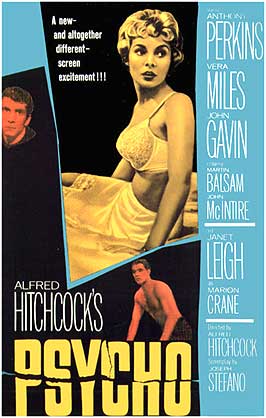 |
| [1]Psycho, 1960 |
Psycho is a 1960's horror thriller directed by Alfred Hitchcock, starring Antony Perkins, Janet Leigh, Vera Miles and John Gavin. The film is about a woman named Marion Crane who steals $40.000 from her employers client (who flaunts the money around) and goes on the run across America. After constant rejection from many motels, she finds herself at "The Bates Motel" which is just off the highway. Here she meets a weird motel proprietor named Norman Bates (Anthony Perkins) who is under the domination of his mother (which we don't know yet). Here is where Marion meets her doom, but is that the end of the story..?
 |
| [2]Norman & Marion (1960) |
After watching the first handful of scenes up to where Marion is buying a new car, the story had already seemed to be established. She has already stolen the money and is on the run, and this anonymous police officer is also following her which also leads the audience to believe that he is onto her and that eventually she will get caught. The fact that the story takes a turn from that scene onwards (after she buys the car) is very mystifying. This confuses the audience, gets them trying to re-anticipate the film and provides more suspense in the long run, this is a good tactic from Hitchcock. What is more confusing is that the main character, Marion, gets killed "prematurely". I say prematurely because we are skillfully manipulated into believing that, since she is the lead character, she will live til the end of the film (or at least the second half of the film). This makes Marion a secondary MacGuffin, after the $40.000, because although it might not be clear to the naked eye, Marion is killed for a reason which we later discover.
The fact that she does die is very baffling to begin with, since everything gathered from the story has now suddenly been turned on its head and we are just left hanging, wondering "so... what now?" Hitchcock's techniques voyeuristically implicate the audience with the universal, dark evil forces and secrets present in the film. This shouldn't surprise you too much if you are an avid Hitchcock fan however, as most of his films run by this layered and complex narrative style. Some may need to see his films more then once to fully grasp the story and all of its subtlety.
[2]"The fact that Crane's murder occurs halfway through the film is a powerful and innovative narrative tool that assaults the viewer's expectations about protagonists." (Justice, 2005)
The concept of killing Marion early, and the actual shower murder scene itself, is one of the most discussed and memorable scenes in cinema history. The scene took an entire week to shoot and is simultaneously horrific and tantalising without any actual penetration of the knife or any visible lady parts. This on the whole was a big gamble by Hitchcock but it was a great success. The effect it has on the audience is that, quite simply, the protagonist is not supposed to die halfway through the movie! Of course, this aspect of the film is part of what makes the legendary shower scene so tragic. Viewing the scene on its own will only leave the majority of people wondering what all the hype is about, but seeing it in the film really makes your mind boggle. The first part of the film was all about getting to know Marion, understanding her situation and creating a subtle bond with the character. This is all part of the process in building the suspense and making that shower scene so, so shocking.
 |
| [3]Norman finds Marion (1960) |
[3]"This isn’t a gory film, and what few instances of violence take place with relatively little actual on-screen violence. In fact, it contains just three big shocks, with the rest of the 110-minute running time devoted to setting scenes, building suspense and playing with our minds." (Panton, 2004)
As said before, Hitchcock cleverly plays with our minds to create the tension this film brings without the use of violence an gore. The centre of attention when looking at the horror of the film is the Bates Motel itself, from its dark and dingy look to its setting in the middle of nowhere. The film bears resemblance to films like "The Haunting (1963)", with the house also being set in a baron location, and "Cat People (1942)" with all its suggestiveness. Psycho has only 3 shock moments, which clearly demonstrates that a horror/thriller can be just as thrilling, if not more, without all the sometimes unnecessary dramatics's of other horrors. Even to this day, film directors fail to understand this and write films full of blood and gore with no story definition to back up these acts. This reason alone is why Psycho still stands as one of the best films in history and should be a real eye opener to those people seeking influence.
[4]"Yet although Psycho laid a blueprint that has been emulated in varying degrees ever since, Hitchcock's original formula for slasher films is still hauntingly original." (Justice, 2004)
Psycho is a very unexpected film, you cannot anticipate anything before you see it; the death of the protagonist is not the only unexpected occurrence. Firstly, the film is shot in black and white, which Hitchcock had supposedly stopped doing sereval films ago. *SPOILER ALERT* Norman actually happens to be a transvestite, who pretends to be his mother (who had died some years ago) and the supposedly smart detective who's supposed to save the day gets killed (quite unexpectedly, but also easily) *SPOILER ALERT OVER*. These choices of circumstances are all quite original to Hitchcock when put together in this way, for example you do not expect a serial murderer to be so quiet and harmless in his portrayal of character (when this film was made), and also be a schizophrenic transvestite.
Another thing about this film is, although its probably hard to believe, Marion and Norman are quite similar characters. They both are "drifters" in the sense that neither of them are comfortable with their lives and they both roam the outside world, seeking answers to some kind of unspoken mysteries of their own. Marion is seeking a real relationship with Loomis, or money, or some kind of escape from her pedestrian role as a secretary. She seeks somewhere where she has more self control over what she does and she wants happiness. Norman is seeking a few things, e.g a stable living, maybe away from his house etc, which is far too complex to capture in the film. The movie suggests that the traditional American "home" is empty and somewhat impersonal, like its just a rented space devoid of tradition and homeliness and just filled with materials used to satisfy personal needs (Normans stuffed birds for example). This establishment of the lack of a base for these characters further adds to the films disorientation value and makes viewers feel more uncomfortable.
Overall, Psycho is just one of those films hailed one of the greatest of all time which will live on for ever. I agree it is a great film with a cleverly written storyline and well executed scenes. If you have yet to see the film, well, what are you waiting for?
As said before, Hitchcock cleverly plays with our minds to create the tension this film brings without the use of violence an gore. The centre of attention when looking at the horror of the film is the Bates Motel itself, from its dark and dingy look to its setting in the middle of nowhere. The film bears resemblance to films like "The Haunting (1963)", with the house also being set in a baron location, and "Cat People (1942)" with all its suggestiveness. Psycho has only 3 shock moments, which clearly demonstrates that a horror/thriller can be just as thrilling, if not more, without all the sometimes unnecessary dramatics's of other horrors. Even to this day, film directors fail to understand this and write films full of blood and gore with no story definition to back up these acts. This reason alone is why Psycho still stands as one of the best films in history and should be a real eye opener to those people seeking influence.
 |
| [4] Sam Loomis Behind Norman Bates (1960) |
[4]"Yet although Psycho laid a blueprint that has been emulated in varying degrees ever since, Hitchcock's original formula for slasher films is still hauntingly original." (Justice, 2004)
Psycho is a very unexpected film, you cannot anticipate anything before you see it; the death of the protagonist is not the only unexpected occurrence. Firstly, the film is shot in black and white, which Hitchcock had supposedly stopped doing sereval films ago. *SPOILER ALERT* Norman actually happens to be a transvestite, who pretends to be his mother (who had died some years ago) and the supposedly smart detective who's supposed to save the day gets killed (quite unexpectedly, but also easily) *SPOILER ALERT OVER*. These choices of circumstances are all quite original to Hitchcock when put together in this way, for example you do not expect a serial murderer to be so quiet and harmless in his portrayal of character (when this film was made), and also be a schizophrenic transvestite.
Another thing about this film is, although its probably hard to believe, Marion and Norman are quite similar characters. They both are "drifters" in the sense that neither of them are comfortable with their lives and they both roam the outside world, seeking answers to some kind of unspoken mysteries of their own. Marion is seeking a real relationship with Loomis, or money, or some kind of escape from her pedestrian role as a secretary. She seeks somewhere where she has more self control over what she does and she wants happiness. Norman is seeking a few things, e.g a stable living, maybe away from his house etc, which is far too complex to capture in the film. The movie suggests that the traditional American "home" is empty and somewhat impersonal, like its just a rented space devoid of tradition and homeliness and just filled with materials used to satisfy personal needs (Normans stuffed birds for example). This establishment of the lack of a base for these characters further adds to the films disorientation value and makes viewers feel more uncomfortable.
 |
| [5] Norman as Mrs Bates (1960) |
Overall, Psycho is just one of those films hailed one of the greatest of all time which will live on for ever. I agree it is a great film with a cleverly written storyline and well executed scenes. If you have yet to see the film, well, what are you waiting for?
Illustration List:
[1] Alfred Hitchcock (1960). Psycho [electronic print] Available at: http://www.filmsite.org/psyc.html
[2] Alfred Hitchcock (1960). Norman & Marion [electronic print] Available at: http://www.obsessedwithfilm.com/features/50-reasons-why-psycho-is-the-greatest-film-of-all-time.php
[3] Alfred Hitchcock (1960). Norman finds Marion [electronic print] Available at: http://collectiverambling.wordpress.com/2010/08/18/a-love-letter-from-norman-bates/
[4] Alfred Hitchcock (1960). Sam Loomis behind Norman Bates [electronic print] Available at: http://www.thelightningbugslair.com/2009/10/hitch-on-hump-psycho-1960-part-3-were.html
[5] Alfred Hitchcock (1960). Norman as Mrs Bates [electronic print] Available at: http://letsrollforums.com/kurt-cobain-mind-control-t17443p32.html?s=b8138ad36703a5c2cb8f119e28d61f38&
Bibliography:
[1]Ebert, Roger (December 6, 1998) Psycho (1960) In: rogerebert.com [online] Available at: http://rogerebert.suntimes.com/apps/pbcs.dll/article?AID=/19981206/REVIEWS08/401010353/1023
[2]Justice, Chris (May 26, 2005) Psycho (1960) In: Classic-Horror.com [online] Available at: http://classic-horror.com/reviews/psycho_1960
[2]Justice, Chris (May 26, 2005) Psycho (1960) In: Classic-Horror.com [online] Available at: http://classic-horror.com/reviews/psycho_1960
[3]Panton, Gary (February 26, 2004) Psycho (1960) In: Movie Gazette [online] Available at: http://movie-gazette.com/656/psycho
[4]Justice, Chris (May 26, 2005) Psycho (1960) In: Classic-Horror.com [online] Available at: http://classic-horror.com/reviews/psycho_1960
[4]Justice, Chris (May 26, 2005) Psycho (1960) In: Classic-Horror.com [online] Available at: http://classic-horror.com/reviews/psycho_1960
Saturday, 12 February 2011
Lifedrawing 8th Feb
Date: 8th February, 2011
Model: Jane
Time: 30 MinutesDescription: Observational (Left) & Memory (Right) Drawing

Date: 8th February, 2011
Model: Jane
Time: 30 MinutesDescription: Observational (Left) & Memory (Right) Drawing

I thought this lesson was alright.
I do feel I made things harder for myself though. With the first pose I think the observational drawing came out better (which is obvious) but it was because I wasn't drawing normally for the memory drawing. I kept rubbing out and redrawing and on the whole was trying too hard to get it right, instead of just drawing from memory the way I usually would.
On the second pose, however, I feel the memory drawing was more successful. I dont know why my observational piece was so off this time but hey.
Date: 8th February, 2011
Model: Jane
Time: 30 MinutesDescription: Drawing in Motion


Wednesday, 9 February 2011
Other uses of a ball bearing
 |
| [1] Ball Bearings |
Ball bearings are small metal balls used in gears to reduce rotational friction, support radial and axial loads to distribute weight evenly. An example of this gear would be in a roller skate wheel
 |
| [2] Ball Bearing in skate wheel |
Ball bearings have been used for a wide variety of things that are useful, but its also used for fun quirky things like obstacle courses, traps, triggers, chain reactions and much more . You see the latter usage of the bearing in media and workshops. Here are some examples of how the bearing can be useful in many different circumstances.
Ball Bearing Roller Coaster:
Board Game: Mouse Trap:
Desk Dots:
[1] Ball Bearings [electronic print] Available at: http://www.mutr.co.uk/advanced_search_result.php?keywords=ball
[2] Ball Bearing in skate wheel [electronic print] Available at: http://www.euro-yo.com/acatalog/How_To.html
Tuesday, 8 February 2011
Story Idea 1
Here's an idea for a story
Setting- Theatre
1. Female Ballet Dancers enter from stage left (line dancing). Audience clap very briefly
Dancers:
- A mixture of slim and fat dancers, all approx same height.
- White/ Pink Tutu's
- Performing a mixture of arabesque moves in sync
2. Once on stage, the dancers form a circle. They perform simultaneous fouette turns while moving anti clockwise around the circle (all in sync)
3. Audience start to boo the dancers.
4. Someone in the audience starts throwing ball bearings at the dancers. He targets the big lady first. She is hit in the chest but is not affected.
5. More bearings are flung at the dancers, slowly building up from one at a time to three, then 5 etc. The slimmest dancers are taken down by the bearings, one by one.
6. We are now down to three dancers, 2 slim 1 fat, fat dancer in the middle and slim either side. (These dancers are the most elegant)
- Dancers are now dancing in a line facing the audience again. Centre stage
7. The crowd is booing and bearings are flying towards the stage like bullets now. The dancers are kept on their toes.
- A Tilt shot of a bearing as it comes towards the stage (Inspired by "The Matrix")
followed by
- Close up shot of big dancers face as she spots the bearing (with a slow motion pan)
8. Big dancer dodges the bearing.
- Slow motion mid cam shot as she performs the dodge
9. The unexpected elegance of the big woman fascinates the crowd, and they start cheering her on (still throwing bearings of course)
10. Show ends with the woman doing some backbreaking arial move which is the climax of the show. She again dodges all bearing launched at her
11.All the other dancers then get up (battered and bruised) and they all curtsy simultaneously. Each and every one of them (apart from the last woman standing) are tired and wilting.
12. Curtains fall
Setting- Theatre
1. Female Ballet Dancers enter from stage left (line dancing). Audience clap very briefly
Dancers:
- A mixture of slim and fat dancers, all approx same height.
- White/ Pink Tutu's
- Performing a mixture of arabesque moves in sync
2. Once on stage, the dancers form a circle. They perform simultaneous fouette turns while moving anti clockwise around the circle (all in sync)
3. Audience start to boo the dancers.
4. Someone in the audience starts throwing ball bearings at the dancers. He targets the big lady first. She is hit in the chest but is not affected.
5. More bearings are flung at the dancers, slowly building up from one at a time to three, then 5 etc. The slimmest dancers are taken down by the bearings, one by one.
6. We are now down to three dancers, 2 slim 1 fat, fat dancer in the middle and slim either side. (These dancers are the most elegant)
- Dancers are now dancing in a line facing the audience again. Centre stage
7. The crowd is booing and bearings are flying towards the stage like bullets now. The dancers are kept on their toes.
- A Tilt shot of a bearing as it comes towards the stage (Inspired by "The Matrix")
followed by
- Close up shot of big dancers face as she spots the bearing (with a slow motion pan)
8. Big dancer dodges the bearing.
- Slow motion mid cam shot as she performs the dodge
9. The unexpected elegance of the big woman fascinates the crowd, and they start cheering her on (still throwing bearings of course)
10. Show ends with the woman doing some backbreaking arial move which is the climax of the show. She again dodges all bearing launched at her
11.All the other dancers then get up (battered and bruised) and they all curtsy simultaneously. Each and every one of them (apart from the last woman standing) are tired and wilting.
12. Curtains fall
-END-
The moral is basically not to judge a book by its cover! It is shown as a comedy to get the point across
Rope Review
Rope
1948:
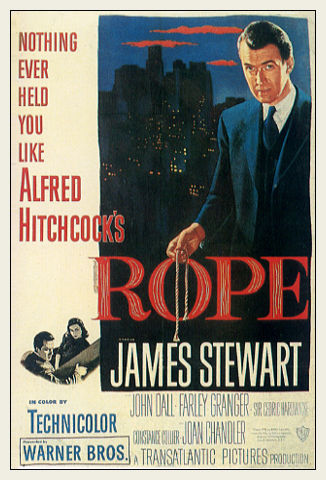 |
| [1]Rope, 1948 Rope, Directed by Alfred Hitchcock, is a film about two men, Brandon Shaw (John Dall) and Phillip Morgan (Farley Granger), who strangle their "inferior" classmate and hide his body in a chest in their apartment. Soon after the murder they hold a dinner party in their apartment, as means to challenge the "perfection" of their crime they had just committed. Rope is a great film which, when at its peak, will have the majority of people bracing themselves while sunk down into their seats; the amount of tension the film brings, along with some quite unexpected outcomes, is quite great. What gives this film even more gratitude is not just the acting however, but also the way it was made. |
 |
| [2] Phillip, Rupert & Brandon. (1948) |
The most famous feature about Rope is that it is (arguably) made with NO CUTS (with an exception of the one you see at the very start moving from the street to the murder scene). Hitchcock refused to include any intentional cuts, the only time cuts were made was when the film reel had to be changed over; this problem cant be avoided. These cuts were disguised by zooming into somebody's back for a couple of seconds them coming out again, this was when the reel would be changed. The film is also only shot from a few angles all on the same side of the room, this makes it feel like they are on a set. Among the different camera shot used, the longshots are the most impactful in portraying emotion. The use of the longshot down the hall when the maid is clearing up for example is very good at creating a high level of tension, it leaves us open to a bunch of outcomes expecially since they made sure to have the chest in the shot as it was slowly being stripped. Another good use of the longshot was when Brandon went to fetch some wine from the fridge. He is talking to the maid, convincing her that wine was fit for the occasion, but the shot used imposes that it is an arkward situation, almost like an "arkward silence' displayed through a camera.
 |
| [3] Phillip & Brandon at the dining table, (1948) |
[2]The man they kill in this opening scene is a friend of theirs who has never done them any wrong. But these two are fucking crazy and just want to pull of a murder. (Quint, 2009)
As for the story, it is very simple and short. Because of this we dont really get to understand what the actual plot of the film is about, for example why these guys decided to murder David and what they planned to do in after the crime. This part of the story that we sit and watch is great, but still doesnt make complete sense in the long run. The reason given for the crime is that Brandon and Phillip were inspired by a theory taught to them by one of their college professors that murder isn’t inherently wrong, but is only reserved for those who are special. That society’s rules are for the inferior. Because this is their only reason behind the murder it leads us to believe that these chaps must have a screw loose, and are even more crazy for believing they could show off about it straight afterwards by holding a dinner party, in celebration, involving the victims parents!
 |
| [4] Brandon on the couch, (1948) |
This is a great scene as it is here you could say that things get "wrapped up", we see how the story is resolved. There is a big debate between the three of them which ends with Rupert feeling almost equally as responsible. He fires shots from the gun he wrestled off of Brandon out of the window and awaits the police. As we hear the sirens getting louder and louder, the flashing neon lights outside shine on their faces. This is very effective because the neons somewhat replicate the police lights and it feels like the film has suddenly fast forwarded to show them after already being caught, hence their miserable states.
Overall, Rope is a great film open to a wide variety of viewers.
Illustration List:
[1] Alfred Hitchcock (1948), Rope [electronic print] Available at: http://hitchcock.tv/mov/rope/rope.html
[2] Alfred Hitchcock (1948), Phillip, Rupert & Brandon [electronic print] Available at: http://www.aintitcool.com/node/42051
[3] Alfred Hitchcock (1948), Phillip & Brandon at the dining table [electronic print] Available at: http://somecamerunning.typepad.com/some_came_running/2008/11/milk-the-boys-in-the-band-and-teh-gay-agenda-in-cinema.html
[4] Alfred Hitchcock (1948), Brandon on the couch [electronic print] Available at: http://www.flickr.com/photos/awkwardboyhero/4861777275/
Bibliography:
[1] Quint (August 14, 2009), A Movie A Week: ROPE (1948) You're quite a goodchicken strangler as I recall. In: Ain't It Cool News [online] Available at: http://www.aintitcool.com/node/42051
[2] Quint (August 14, 2009), A Movie A Week: ROPE (1948) You're quite a goodchicken strangler as I recall. In: Ain't It Cool News [online] Available at: http://www.aintitcool.com/node/42051
[3] Muir, John Kenneth (September 07, 2008), Cult Movie Review: Rope (1948). In: John Kenneth Muir's Reflections on Film/TV [online] Available at: http://reflectionsonfilmandtelevision.blogspot.com/2008/09/cult-movie-review-rope-1948.html
Subscribe to:
Posts (Atom)