Thursday, 24 February 2011

The Birds: Review

The Birds
1963

[1]The Birds, (1963)

"The Birds" is a Horror/Thriller film directed by Alfred Hitchcock, starring Rod Taylor (as Mitch Brenner), Tippi Hedren (as Melanie Daniels) and Jessica Tandy (as Lydia Brenner)


[2]Mitch Brenner surrounded by birds, (1963)


The Birds is, for the most part, quite a horrific film. Trying to imagine one self in the same position Brenner and his family are in, having to live through the same experience and suffer the same consequences with no warning at all, is quite horrendous. By looking at the film in a different light however, similar to the way Scheib describes, it can become quite hilarious. The fact that this girl called Melanie Daniels has come to town unexpectedly, and now suddenly the place has been taken over by birds of different kinds is amusing. The amusement is born from the confusion everyone (including the audience) is facing. The most important thing overall is that this puzzling story with crazy birds is what makes The Birds what it is, without the bird factor there is no conflict, and without conflict there would potentially be no film because everyone will just live happily ever after (which doesnt happen in the majority of horrors).


[3]Melanie at the bar, (1963)


As well as a puzzling story, the film also has a lot of prolonged scenes of people just looking at eachother or something in the distance. Now, there is a difference between it being a reasonably prolonged shot, and when the shot is just noticably too long for no apparent reason (which woud be classed as unprofessional nowadays). An example of a shot "over done" would be when the teacher (Annie Hayworth) is shutting the doors at the birthday party after getting all the children inside; 2 kids poke their heads around each of Hayworths thighs and stare into the sky for a good 5-7 seconds. There is no justification for this as it doesnt lead us anywhere and the children dont even have any lines at that point, the scene just simply fades out into the next.

Another oddity of this film is the birds sometime-ish behaviour. From early on we see that the birds of Bodega Bay are more ferocious then in other areas, starting with a seagull's solo attack on Melanie to get the ball rolling (and to act as a warning) followed by bigger more planned attacks by gangs of birds as the film goes on. On the odd occasion however, the birds will just sit and watch as Melanie just walks right by. This is evidently done to build suspense, because Hitchcock has cleverly decided to show some mercy in the scenes the audience is more likely to expect an attack to occur, but at the same time it makes the film a bit silly. Yes seagull's, crows and raven's all have minds of their own, but surely they are more likely to strike their prey when its out in the open and not barricaded inside a house with layers of wood nailed to each and every opening...come on now!


[4]Mitch barricading door, (1963)

In terms of the actual story I agree with Warren's statement, and feel the emphasis of the birds overshadow the story of Melanie Daniels. The film is good, but not that good compared to Hitchcock's other films like Psycho for instance. The fact that Daniels indeed isn't likable also puts towards the point that its hard to make a connection with her as an audience. The detrimental effect of this is that we do not grasp the whole concept of why this havoc is taking place as well as we should. However, the film isn't all that bad and is worth a watch.

Illustration List:

[1] Alfred Hitchcock (1963), The Birds [electronic print] Available at: http://en.wikipedia.org/wiki/The_Birds_(film)

[2] Alfred Hitchcock (1963), Mitch Brenner surrounded by birds [electronic print] Available at: http://www.brummieblogs.com/2007/BBFebruary2007.htm

[3] Alfred Hitchcock (1963), Melanie at the bar [electronic print] Available at: http://bavatuesdays.com/the-birds/

[4] Alfred Hitchcock (1963), Mitch barricading door [electronic print] Available at: http://robie2008.wordpress.com/100-best-greatest-favorite-films/

Bibliography:

[1] Scheib, Richard (1999-2011), The Birds In: 0to5stars-moria.ca [online] Available at: http://0to5stars-moria.ca/horror/birds-1963.htm

[2] Scheib, Richard (1999-2011), The Birds In: 0to5stars-moria.ca [online] Available at: http://0to5stars-moria.ca/horror/birds-1963.htm

[3] Sponseller, Brandt (2001), The Birds (1963) In: Classic-Horror.com [online] Available at: http://classic-horror.com/reviews/birds_1963b

[4] Warren, Bill (March 28, 2000), Birds, The (Collector's Edition) In: Audio Video Revolution [online] Available at: http://www.avrev.com/dvd-movie-disc-reviews/mystery-suspense/birds-the-collectors-edition.html

Tuesday, 15 February 2011

Forgotten Tutorials

Forgot to post these after I done them, but here they are anyway (better late then never)

Double-sided book page


Blood Vessel

Ballerina sketches and development

Here were just some preliminary sketches of ballerina's of different shapes and sizes, all in different poses. I like the botom left and middle rigt ones the most, I was thinking the majority of the dancers would look like the slim one while maybe one or 2 will lok like the bigger one.

Again a couple of quick sketches. The top one was done to remember a ballet move that I saw in a video somewhere, the bottom one was to try and get the pose of a spinning move or leg extention correct.


These drawings are more related to my V3 script.  Here is a design for the dancers dress from the front and back. The dress is not an ordinary tutu, this dress comes equipped with beads over the torso with ball bearings along the rim of the tutu (all for glitzy decorational reasons).
The bottom sketch is how I envision a certain scene to look like in terms of the shot used and whats going on in the scene (first instance of ball bearings coming loose from the dresses)


Again this is another quick sketch experimenting with drawing from a specific camera angle I want to use in a scene. Its a slightly foreshortening shot watching a ball bearing shoot up into the roof where the show lights are. The top image is showing how the spotlight becomes immobilized and no longer follows the dancers.

Research:- Tom And Jerry: Piano Rhapsody Episode

Whilst thinking of new ideas for my ballet animation, I decided to think deep about anything I knew about that has already been used in media which related to opera or ballet. I was specifically looking for film or cartoon that shows some sort of creativity, chaos or comedy within the ballet/opera performance besides the performance itself.

I remember in my earlier days I always used to watch Tom & Jerry (I think Ive seen all the episodes) and I remember a specific episode being about a stage performance which Tom being the pianist and Jerry being the one trying to ruin everything. After a quick search I have found out that the music is actually a real symphony called Hungarian Rhapsody, No. 2 by Franz Liszt. This Tom & Jerry episode was simply an expressionistic take made to show how the musics highs and lows could be expressed visually in a cartoon, from one persons opinion/point of view (this being Fred Quimby's take). This was all nice to figure out as, of course, I didn't know this when I watched this episode for the first time as I was only about 6 or 7.


Now, how can this be used for my animation?

Well when I watch this I find it very inspiring. Although it has no ballet in it, I still see this as relative reference material because its set in a theatre or opera house, which is where a ballet is likely to be. The music they would dance to is also similar. The main reason I like this though is because it gives me ideas for how I could turn my simple ballet performance idea into something funny, chaotic and generally interesting to watch. This episode is a good example of how a simple concert could be turned into catastrophy and i will be refering to it to to create some ideas for my project.

@Phil Script

Sorry for the late submission, but here is the script.


Big Ballet Bonanza Script V3

Sunday, 13 February 2011

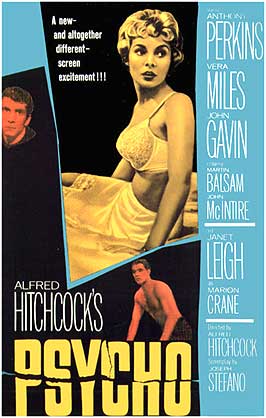
Psycho Review

Psycho
1960

[1]Psycho, 1960
Psycho is a 1960's horror thriller directed by Alfred Hitchcock, starring Antony Perkins, Janet Leigh, Vera Miles and John Gavin. The film is about a woman named Marion Crane who steals $40.000 from her employers client (who flaunts the money around) and goes on the run across America. After constant rejection from many motels, she finds herself at "The Bates Motel" which is just off the highway. Here she meets a weird motel proprietor named Norman Bates (Anthony Perkins) who is under the domination of his mother (which we don't know yet). Here is where Marion meets her doom, but is that the end of the story..?

[2]Norman & Marion (1960)


After watching the first handful of scenes up to where Marion is buying a new car, the story had already seemed to be established. She has already stolen the money and is on the run, and this anonymous police officer is also following her which also leads the audience to believe that he is onto her and that eventually she will get caught. The fact that the story takes a turn from that scene onwards (after she buys the car) is very mystifying. This confuses the audience, gets them trying to re-anticipate the film and provides more suspense in the long run, this is a good tactic from Hitchcock. What is more confusing is that the main character, Marion, gets killed "prematurely". I say prematurely because we are skillfully manipulated into believing that, since she is the lead character, she will live til the end of the film (or at least the second half of the film). This makes Marion a secondary MacGuffin, after the $40.000, because although it might not be clear to the naked eye, Marion is killed for a reason which we later discover.
The fact that she does die is very baffling to begin with, since everything gathered from the story has now suddenly been turned on its head and we are just left hanging, wondering "so... what now?" Hitchcock's techniques voyeuristically implicate the audience with the universal, dark evil forces and secrets present in the film. This shouldn't surprise you too much if you are an avid Hitchcock fan however, as most of his films run by this layered and complex narrative style. Some may need to see his films more then once to fully grasp the story and all of its subtlety.
The concept of killing Marion early, and the actual shower murder scene itself, is one of the most discussed and memorable scenes in cinema history. The scene took an entire week to shoot and is simultaneously horrific and tantalising without any actual penetration of the knife or any visible lady parts. This on the whole was a big gamble by Hitchcock but it was a great success. The effect it has on the audience is that, quite simply, the protagonist is not supposed to die halfway through the movie! Of course, this aspect of the film is part of what makes the legendary shower scene so tragic. Viewing the scene on its own will only leave the majority of people wondering what all the hype is about, but seeing it in the film really makes your mind boggle. The first part of the film was all about getting to know Marion, understanding her situation and creating a subtle bond with the character. This is all part of the process in building the suspense and making that shower scene so, so shocking.

[3]Norman finds Marion (1960)

[3]"This isn’t a gory film, and what few instances of violence take place with relatively little actual on-screen violence. In fact, it contains just three big shocks, with the rest of the 110-minute running time devoted to setting scenes, building suspense and playing with our minds." (Panton, 2004)

As said before, Hitchcock cleverly plays with our minds to create the tension this film brings without the use of violence an gore. The centre of attention when looking at the horror of the film is the Bates Motel itself, from its dark and dingy look to its setting in the middle of nowhere. The film bears resemblance to films like "The Haunting (1963)", with the house also being set in a baron location, and "Cat People (1942)" with all its suggestiveness. Psycho has only 3 shock moments, which clearly demonstrates that a horror/thriller can be just as thrilling, if not more, without all the sometimes unnecessary dramatics's of other horrors. Even to this day, film directors fail to understand this and write films full of blood and gore with no story definition to back up these acts. This reason alone is why Psycho still stands as one of the best films in history and should be a real eye opener to those people seeking influence.


[4] Sam Loomis Behind Norman Bates (1960)


[4]"Yet although Psycho laid a blueprint that has been emulated in varying degrees ever since, Hitchcock's original formula for slasher films is still hauntingly original." (Justice, 2004)

Psycho is a very unexpected film, you cannot anticipate anything before you see it; the death of the protagonist is not the only unexpected occurrence. Firstly, the film is shot in black and white, which Hitchcock had supposedly stopped doing sereval films ago. *SPOILER ALERT* Norman actually happens to be a transvestite, who pretends to be his mother (who had died some years ago) and the supposedly smart detective who's supposed to save the day gets killed (quite unexpectedly, but also easily) *SPOILER ALERT OVER*. These choices of circumstances are all quite original to Hitchcock when put together in this way, for example you do not expect a serial murderer to be so quiet and harmless in his portrayal of character (when this film was made), and also be a schizophrenic transvestite.

Another thing about this film is, although its probably hard to believe, Marion and Norman are quite similar characters. They both are "drifters" in the sense that neither of them are comfortable with their lives and they both roam the outside world, seeking answers to some kind of unspoken mysteries of their own. Marion is seeking a real relationship with Loomis, or money, or some kind of escape from her pedestrian role as a secretary. She seeks somewhere where she has more self control over what she does and she wants happiness. Norman is seeking a few things, e.g a stable living, maybe away from his house etc, which is far too complex to capture in the film. The movie suggests that the traditional American "home" is empty and somewhat impersonal, like its just a rented space devoid of tradition and homeliness and just filled with materials used to satisfy personal needs (Normans stuffed birds for example). This establishment of the lack of a base for these characters further adds to the films disorientation value and makes viewers feel more uncomfortable.


[5] Norman as Mrs Bates (1960)

Overall, Psycho is just one of those films hailed one of the greatest of all time which will live on for ever. I agree it is a great film with a cleverly written storyline and well executed scenes. If you have yet to see the film, well, what are you waiting for?

Illustration List:

[1] Alfred Hitchcock (1960). Psycho [electronic print] Available at: http://www.filmsite.org/psyc.html

[2] Alfred Hitchcock (1960). Norman & Marion [electronic print] Available at: http://www.obsessedwithfilm.com/features/50-reasons-why-psycho-is-the-greatest-film-of-all-time.php

[3] Alfred Hitchcock (1960). Norman finds Marion [electronic print] Available at: http://collectiverambling.wordpress.com/2010/08/18/a-love-letter-from-norman-bates/

[4] Alfred Hitchcock (1960). Sam Loomis behind Norman Bates [electronic print] Available at: http://www.thelightningbugslair.com/2009/10/hitch-on-hump-psycho-1960-part-3-were.html

[5] Alfred Hitchcock (1960). Norman as Mrs Bates [electronic print] Available at: http://letsrollforums.com/kurt-cobain-mind-control-t17443p32.html?s=b8138ad36703a5c2cb8f119e28d61f38&

Bibliography:

[1]Ebert, Roger (December 6, 1998) Psycho (1960) In: rogerebert.com [online] Available at: http://rogerebert.suntimes.com/apps/pbcs.dll/article?AID=/19981206/REVIEWS08/401010353/1023

[2]Justice, Chris (May 26, 2005) Psycho (1960) In: Classic-Horror.com [online] Available at: http://classic-horror.com/reviews/psycho_1960

[3]Panton, Gary (February 26, 2004) Psycho (1960) In: Movie Gazette [online] Available at: http://movie-gazette.com/656/psycho

[4]Justice, Chris (May 26, 2005) Psycho (1960) In: Classic-Horror.com [online] Available at: http://classic-horror.com/reviews/psycho_1960