"Musketeer History
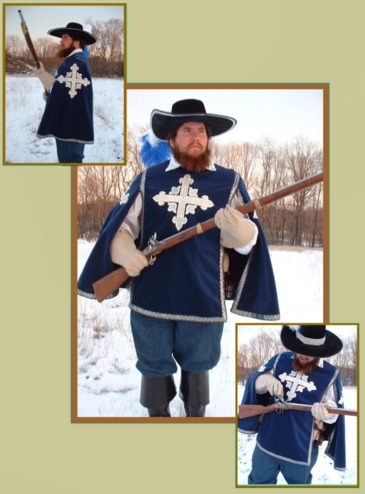
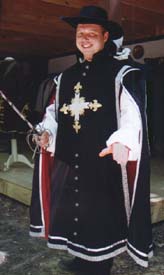
In the year 1600, King Henry IV created an elite force to serve as his personal guard and armed them with muskets. They were disbanded in 1646, and later reformed in 1657. These 150 musketeers were known as "Gray Musketeers" because of the gray horses they all rode, until the king, on a whim, gave them all black stallions and changed their monicre to "Black Musketeers". They were again disbanded in 1776, again reembodied, and disbanded again for the final time in 1791. Some have asked why the Musketeers in Dumas' writings did not carry muskets (a logical question). The answer lies in the strict code of ethics and honor that these men lived by. The king's Musketeers were personal bodyguards, and were held to be the noblest and most renown fighters of their day, and for them to use a firearm instead of a blade would have been unthinkable, leaving the lesser ranks of Musketeers to kill their enemies from a distance." (Necessary, 2010)
In the year 1600, King Henry IV created an elite force to serve as his personal guard and armed them with muskets. They were disbanded in 1646, and later reformed in 1657. These 150 musketeers were known as "Gray Musketeers" because of the gray horses they all rode, until the king, on a whim, gave them all black stallions and changed their monicre to "Black Musketeers". They were again disbanded in 1776, again reembodied, and disbanded again for the final time in 1791. Some have asked why the Musketeers in Dumas' writings did not carry muskets (a logical question). The answer lies in the strict code of ethics and honor that these men lived by. The king's Musketeers were personal bodyguards, and were held to be the noblest and most renown fighters of their day, and for them to use a firearm instead of a blade would have been unthinkable, leaving the lesser ranks of Musketeers to kill their enemies from a distance." (Necessary, 2010)
Also, in conjuction with having an eagle as a sidekick I decided to look up whether they actualy did use them or not. It turns out that Napoleon had a golden eagle on the end of his staff, along with the letter N. Regimens liks the squadron of the Horse Grenadiers also carried them mounted on top of the blue regimental flagpole in battle. This eagle is said to bare the same significance to French Imperial regiments as the colours did to British regiments, and to lose the Eagle would bring shame to the regimen. Also The Fusiliers (the french infantry of the 1800s) were said to be a later version of the Musketeer in a sense, so having an eagle as a sidekick might not be such a bad idea.


"The Fusiliers made up the majority of a line infantry battalion, and may be considered the typical infantryman of the Grande Armée. The Fusilier was armed with a smoothbore, muzzle-loaded flintlock Charleville model 1777 musket and a bayonet. Fusilier training placed emphasis on speed of march and endurance, along with individually aimed fire at close range and close quarters combat. This differed greatly from the training given to the majority of European armies, which emphasised moving in rigid formations and firing massed volleys. Many of the early Napoleonic victories were due to the ability of the French armies to cover long distances with speed, and this ability was thanks to the training given to the infantry. From 1803, each battalion comprised eight Fusilier companies. Each company numbered around 120 men.
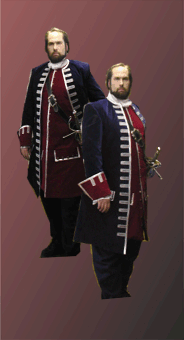
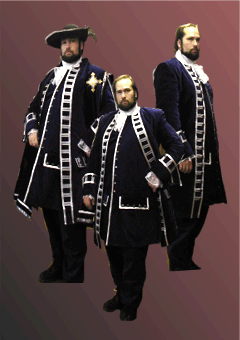
In 1805, one of the Fusilier companies was dissolved and reformed as a Voltigeur company. In 1808, Napoleon reorganised the Infantry battalion from nine to six companies. The new companies were to be larger, comprising 140 men, and four of these were to be made up of Fusiliers, one of Grenadiers, and one of Voltigeurs.The line Fusilier wore a bicorne hat, until this was superseded by the shako in 1807. The uniform of a Fusilier consisted of white trousers, white surcoat and a dark blue coat (the habit long model until 1812, thereafter the habit veste) with white lapels, red collar and cuffs. Each Fusilier wore a coloured pom-pom on his hat. The colour of this pom-pom changed depending on the company the man belonged to. After the 1808 reorganisation, the First company was issued with a dark green pom-pom, the second with sky blue, the third with orange and the fourth with violet."- wiki
http://www.clfc.org/articles/musketeers.htm